金環太子宮 Circle Logo W

Rejoice in giving, sow good seeds widely.

After drawing a fortune stick, practicing good deeds and charity can further fulfill your blessings. Jin Huan Taizi Palace thanks all benefactors for their recognition and support. All donations received will be fully used for the promotion of the temple and charitable causes. May Brother Qiu bless you, may all your wishes be fulfilled, and may all your endeavors be smooth.
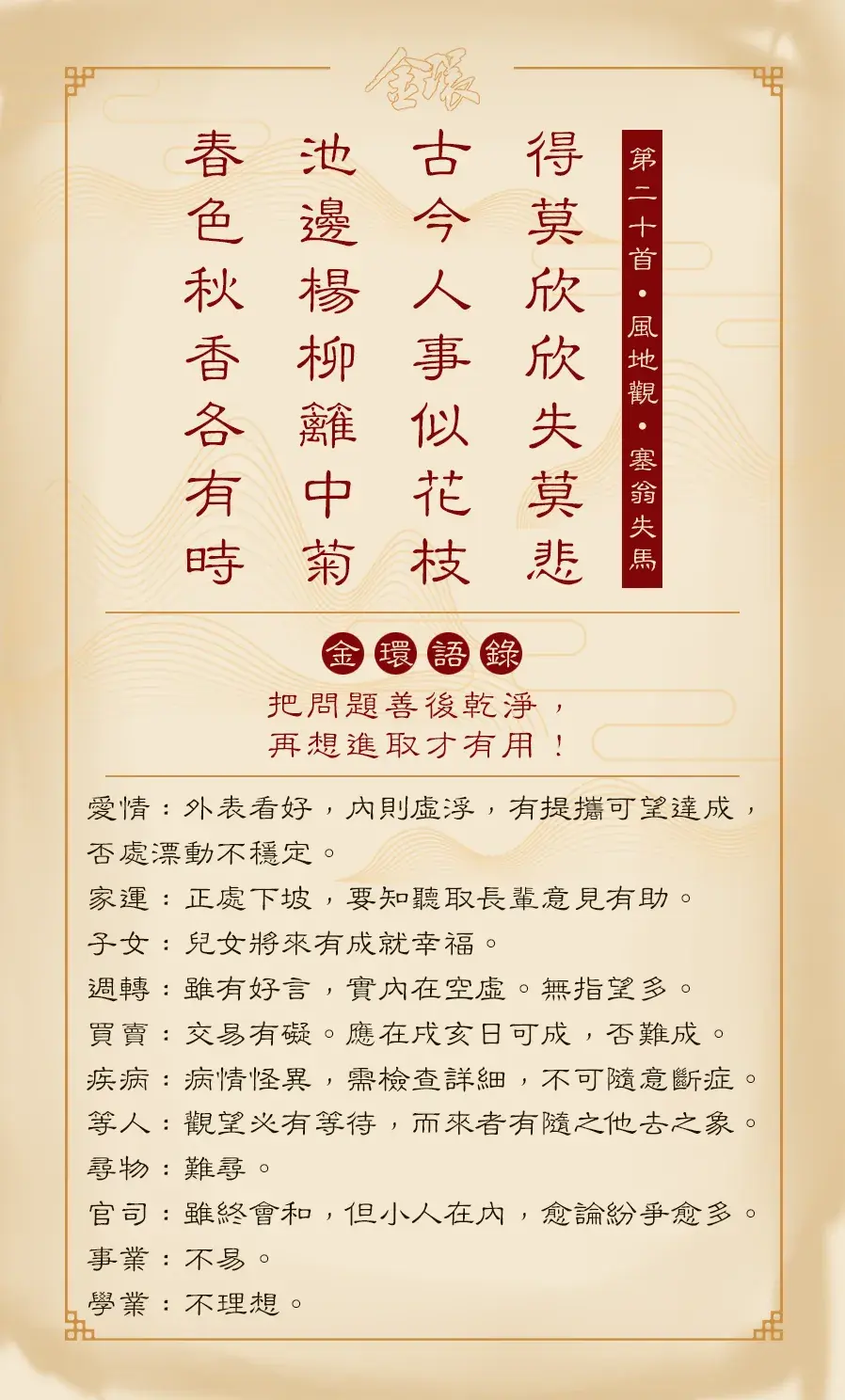
Golden Ring Fortune Slip

The Twentieth Poem: [Feng Di Guan, The Old Man Lost His Horse]

Joy in life, sorrow in death.

The affairs of men, in ancient and modern times, are like branches of flowers.

Willow by the pond, chrysanthemums by the fence.

Spring colors and autumn fragrances have their time.

  • Love: Looks good on the surface but is hollow within. With support, there's hope for achievement; otherwise, it's unstable and prone to drifting.
  • Family fortune: Currently on the decline. Knowing to listen to the advice of elders will help.
  • Children will achieve success and happiness in the future.
  • Turnover: Though there are good words, the inside is actually empty. Little hope.
  • Trade: Trade is hindered. It should be achievable on a Xu Hai day, otherwise it will be difficult to achieve.
  • Illness: The condition is bizarre and requires a thorough examination; diagnosis should not be made casually.
  • Waiting: Observation guarantees waiting, and the arrival of someone implies they will also depart.
  • Lost item: Hard to find.
  • Lawsuit: Although it will eventually be settled, there are villains within, and the more it is discussed, the more disputes will arise.
  • Business: Unchanging.
  • Academics: Not ideal.
Hexagram interpretation:
The so-called "Guan" means to look up from below. In this hexagram, the lower trigram "Kun" represents the "people," and the upper trigram "Xun" represents "commands." Therefore, it means that the ruler above issues commands, and the myriad people look up in reverence. This is also the meaning of "Guan." Looking at the hexagram's form, the fifth and top lines are strong and yang, positioned above, while the remaining four yin lines are below, looking up. Therefore, it is named the "Guan" hexagram.
第二十首正面(觀)
Front of the fortune slip
第二十首背面(觀)
Back of the fortune slip

Clear up the mess from the problem.
You'll only make progress if you aim higher!

Interpretation of fortune stick person

Sai Weng is a fictional character. The idiom “Sai Weng's horse lost, who knows if it is a blessing in disguise” is already commonly used today, originating from the "Ren Jian Xun" chapter of Huainanzi, compiled under the direction of Liu An of the Western Han Dynasty. The story goes like this: Once upon a time, an old man lived in a border area adjacent to the Hu people, and travelers who came and went respectfully called him "Sai Weng." Sai Weng was naturally optimistic and had an unconventional way of dealing with people and matters.

Annotation

Don't be overjoyed when you gain something, don't be overly sad when you lose something: A famous line by Song Dynasty poet Tao Bi. Don't be too happy or too proud when you gain something, and don't be too sad when you lose something. Human affairs and worldly matters, from ancient times to the present, are like flower branches: From ancient times to the present, people and events are like flower stalks and branches; flowers bloom and fall in due course. Willow by the pond, chrysanthemum in the fence: Whether it's willows by the pond or chrysanthemums in a fence. Spring colors and autumn fragrances each have their time: Willows in spring and chrysanthemums in autumn each have their most suitable seasons for growth.

Vernacular

When you gain something, don't be too happy or too proud; when you lose something, don't be too sad. From ancient times to the present, people and events are like flowers and tree trunks; blooming and wilting flowers all have their seasons. Whether it's the willow trees by the river or the chrysanthemums in the fence. The willows in spring and the chrysanthemums in autumn each have their most suitable growing seasons.

Fortune telling by lot

A farmer lost his horse, who knew if it was a misfortune? The farmer gained a horse, who knew if it was a blessing? Between gain and loss, it's hard to distinguish between misfortune and blessing. Facing various difficulties, when the time is right, a solution will naturally arise. This lot indicates that your luck is not yet ideal; it's best to be conservative in all matters and await your opportune moment. For career advancement: It exists, but it's merely a nominal reputation. You must further enrich yourself to truly deserve it. For illness: Pray for divine intervention. For marriage: Marriage will be delayed. A second attempt may succeed. For travel: Traveling alone is ill-omened; traveling with others is advisable.

Divination Meaning

This hexagram is named "Guan," meaning observation and contemplation. It reveals the profound significance of beautiful things in inspiring the human heart, as well as the principles of self-reflection and cultivating virtue, observing subordinates to guide them rightly, and fostering a broad vision. One should not make hasty decisions but rather observe the situation before making plans. Especially in dealings with superiors or those in higher positions, one must be observant and cautious, not taking things lightly. The image of wind (Xun) blowing over the earth (Kun) symbolizes a superior touring and inspecting. This suggests that matters are still under consideration. As Kun signifies gentleness, one should comply with the wishes of superiors at this time. By not overly asserting oneself, one can gain appreciation and stand out.