金環太子宮 Circle Logo W

Rejoice in giving, sow good seeds widely.

After drawing a fortune stick, practicing good deeds and charity can further fulfill your blessings. Jin Huan Taizi Palace thanks all benefactors for their recognition and support. All donations received will be fully used for the promotion of the temple and charitable causes. May Brother Qiu bless you, may all your wishes be fulfilled, and may all your endeavors be smooth.
Golden Ring Fortune Slip

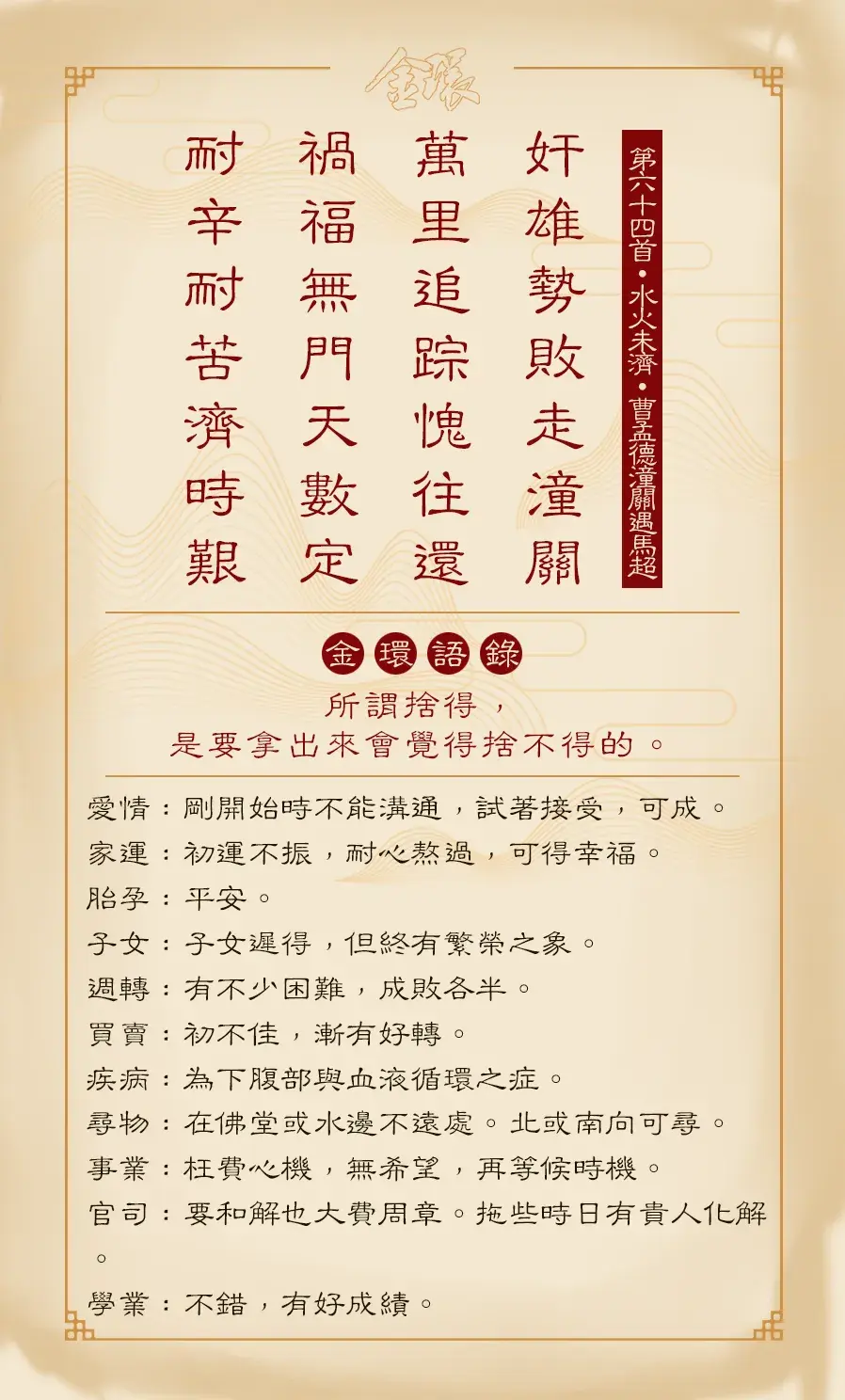
Sixty-fourth poem [Fire over Water, Cao Mengde Encounters Ma Chao at Tongguan]

The treacherous warlord's power collapses and he flees to Tong Pass,

A thousand miles pursued, ashamed to return.

Misfortune and happiness have no fixed abode; fate determines them.

Endure hardship and toil to overcome difficult times.

  • Love: Initial communication difficulties, try to accept, can succeed.
  • Family fortune: Initial luck is not good, be patient and get through it, happiness can be obtained.
  • Pregnancy: Safe.
  • Children: Although children may come later, there are ultimately signs of prosperity.
  • Turnover: There are many difficulties, with an equal chance of success or failure.
  • Buying and selling: Initially not good, gradually improving.
  • Illness: A condition of the lower abdomen and blood circulation.
  • Seeking: Near a Buddhist altar or water. Can be sought to the north or south.
  • Business: Wasted effort, no hope, waiting for the right time.
  • Legal matters: Even reaching a settlement would be a big hassle. Delaying it will lead to a benefactor resolving the issue.
  • Academics: Good, with good grades.
Hexagram interpretation:
Wei Ji is the opposite of Ji Ji, meaning that it has not yet received help and has not succeeded. The upper trigram is Li, which represents "fire"; the lower trigram is Kan, which represents "water." This means fire is above water. We know that fire burns upwards, and water has a lubricating and downward effect. However, now water is below and fire is above. Water and fire cannot be in their proper places and thus cannot exert their functions, meaning they cannot help each other and achieve their full potential. This is the meaning of Wei Ji. On the one hand, the Kan trigram represents a middle-aged man; the Li trigram represents a middle-aged woman. Now the Kan trigram is below and the Li trigram is above, indicating that a middle-aged woman is above a middle-aged man. This contradicts common sense and is not in its proper position. It also indicates a state of not yet being married. Therefore, they cannot achieve the effect of mutual help, which is also the meaning of Wei Ji. Thus, its symbolic meaning is named the "Wei Ji Hexagram."
第六十四首正面(未濟)
Front of the fortune slip
第六十四首背面(未濟)
Back of the fortune slip

The saying goes, "to give and to gain."
It's something you'd be reluctant to part with.

Interpretation of fortune stick person

Cao Cao, courtesy name Mengde, childhood name Aman, a Han Chinese from Qiao, Pei State (present-day Bozhou, Anhui). A renowned statesman, military strategist, and literary figure of the late Eastern Han Dynasty. He was the founder of the Cao Wei regime during the Three Kingdoms period, initially serving as the Grand General and Chancellor of the Eastern Han Dynasty, and later as the King of Wei. After his son Cao Pi ascended the throne as emperor, Cao Cao was posthumously honored as Emperor Wu of Wei.

Annotation

The treacherous villain's defeat and flight to Tong Pass: "Treacherous villain" refers to Cao Cao. Cao Cao was utterly, miserably defeated in the Battle of Tong Pass. Pursuing him for ten thousand miles, he was ashamed to return: His expeditions south and north, flanking maneuvers, and surprise attacks all failed. Misfortune and fortune have no fixed abode; fate determines: Disasters and blessings are not predestined; they are self-inflicted. Enduring hardship to overcome present difficulties: Enduring hardship to save the current situation, turning a crisis into safety.

Vernacular

Cao Cao, disheveled and utterly defeated, never imagined he would lose the Battle of Tong Pass so miserably. With a face full of shame, he tore down the army banner, covered his face, and fled for his life. Afterward, his attempts to conquer the south, maneuver and outflank the enemy, and attack when they were unprepared all failed. Calamity and fortune are not predetermined; they are caused by people themselves. Even someone as meticulous and resourceful as Cao Cao, in the end, found that human plans could not overcome fate, and he returned in utter defeat.

Fortune telling by lot

Cao Cao suffered a hidden loss in the Battle of Tong Pass and fled after several consecutive defeats. This indicates that the divination is not an ideal one, and it is better to plan carefully before acting lest you make a rash move. This hexagram tells the person involved that perseverance is the key to success. Do not fear difficulties, do not shrink from effort, and certainly do not give up halfway, lest all your efforts be in vain. However, haste is also unhelpful; success depends on human effort. Fame and Fortune: Hopes for success in the winter of the second half of the year. Travel: Good in the winter of the second half of the year. Wealth: Prosperity will gradually increase in the seventh and eighth months. Health: No fear after passing the辰 (Chen) and 巳 (Si) periods. General Affairs: Progressing towards the south is advantageous.

Divination Meaning

This hexagram is named "Wei Ji," meaning "not yet completed." It reveals that when an undertaking is not yet finished, one should adhere to moderation and proceed with caution. This principle will gradually lead things toward success. Wei Ji signifies disharmony between yin and yang and a lack of smooth flow in qi and blood. It represents an image of minor good fortune within misfortune. Unsmooth emotions are the biggest influencing factor in people's affairs. This hexagram is the last in the "Xu Gua Zhuan" sequence, generally symbolizing a new beginning. It indicates a great change from extreme misfortune to good fortune, where all ill omens will gradually clear up like the sun after rain, and wishes are worth waiting for. Kan represents water flowing downwards, and Li represents fire rising upwards. When water and fire do not mix, they cannot complement each other. The yin and yang positions are out of order, resulting in a phenomenon where nothing can be accomplished.